Glock handguns stand as a testament to practical engineering: reliable, accurate, and remarkably easy to use. Born from Austrian military requirements, these pistols have found a home with forces, agencies, and civilians worldwide, celebrated for their straightforward design and robust performance. But for a certain segment of enthusiasts, one particular iteration holds a special place: the Gen 3. When it comes to diving deep into specific Glock Gen 3 models & calibers—especially with an eye toward maximizing customization—you’re exploring a sweet spot in the handgun world.
This isn't just about owning a firearm; it's about building a personalized tool that performs exactly how you need it to, and the Gen 3 is arguably the best canvas for that journey.
At a Glance: Why Glock Gen 3 Still Reigns for Customization
- The Customization King: The Gen 3 boasts the largest aftermarket support of any Glock generation, making it the go-to for upgrades.
- Affordable Entry: Often the most budget-friendly option, leaving more room in your wallet for parts.
- Defining Features: Characterized by its accessory rail, finger grooves, thumb rests, and a third locking block pin.
- Popular Calibers: Available in a wide array, from the ubiquitous 9mm to the potent 10mm Auto and .45 ACP.
- Iconic Models: Includes classics like the G17, G19, G22, and G21, providing excellent platforms for various uses.
- Endless Upgrades: Barrels, slides, sights, and triggers are just the beginning; the possibilities are vast.
The Enduring Appeal of Glock Gen 3: Your Customization Canvas
First introduced in 1998, the Glock Gen 3 quickly became a benchmark. It brought with it a series of enhancements that fundamentally shaped the Glock experience, most notably the addition of a universal accessory rail (often called a Picatinny or Weaver rail) for lights and lasers, finger grooves for improved grip, and a loaded chamber indicator. Internally, a third locking block pin was added for enhanced durability, particularly in higher-pressure calibers.
While subsequent generations have refined ergonomics and internal components, the Gen 3 remains undeniably popular. Why? Because it hit a critical point in Glock’s evolution, offering a solid, dependable platform just as the aftermarket industry truly exploded. This perfect timing means that if you own a Gen 3, you have access to an unparalleled selection of parts and accessories. It's truly the "customization king," often available at a more accessible price point than newer models, making it an ideal foundation for a personalized build. You can find comprehensive details about its evolution and distinct characteristics by exploring Understanding Glock Generation 3.
Of course, no design is without its quirks. The Gen 3's finger grooves, while intended to improve grip, can be divisive. Some shooters find them perfectly natural, while others feel they don't quite align with their hand shape. However, this is often a minor point for those planning extensive modifications, as grips can be stippled or modified to individual preference.
Decoding Glock Calibers: Matching Power to Purpose
One of Glock's strengths is its diverse caliber offerings, ensuring there's a model suited for nearly any application. Understanding the ballistic profile and common uses for each caliber is crucial when selecting your Gen 3.
9mm: The Universal Standard
The 9mm cartridge is, without a doubt, the most popular handgun caliber globally. Adopted by NATO forces and the US military, it's celebrated for its balanced attributes: reliable feeding, affordable ammunition, and widespread availability. Ballistically, it offers proven performance with good stopping power, decent range, and manageable recoil, making it an excellent choice for everything from personal protection to range training.
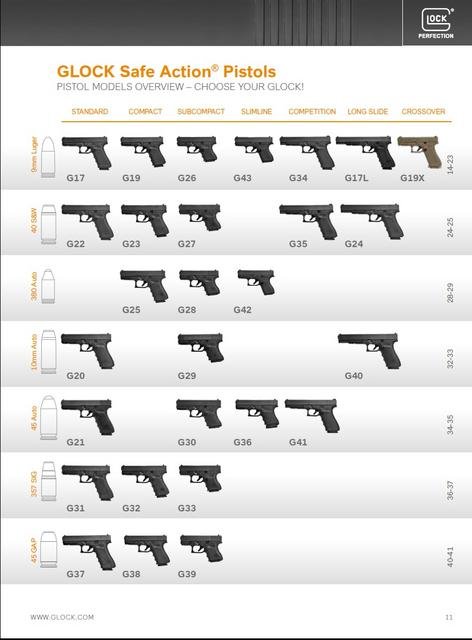
- Gen 3 Models: Glock 17 (full-size), Glock 19 (compact), Glock 26 (subcompact).
.40 S&W: The Law Enforcement Favorite
Born from a collaboration between Smith & Wesson and Winchester, the .40 S&W aimed to bridge the gap between 9mm and .45 ACP. It delivers powerful ballistics for demanding applications while maintaining a higher magazine capacity than .45 ACP. Many law enforcement agencies adopted the .40 S&W due to its perceived increased stopping power over 9mm, making it a common and respected duty round.
- Gen 3 Models: Glock 22 (full-size), Glock 23 (compact), Glock 24 (long-slide), Glock 27 (subcompact), Glock 35 (competition, optics-ready).
.45 ACP: The Big Bore Classic
The venerable .45 ACP, designed by John Browning, is renowned for its heavy bullet and impressive energy release. It’s often prized for its remarkable precision and significant "thump" upon impact. While it typically means lower magazine capacity compared to 9mm or .40 S&W, many shooters value its potent performance and historical significance.
- Gen 3 Models: Glock 21 (full-size), Glock 30 (subcompact), Glock 36 (Slimline - though this is a unique model, the Gen 3 G36 is slightly different from the Slimline family mentioned in the ground truth for Gen 5).
10mm Auto: The Powerhouse
The 10mm Auto is a high-velocity, high-energy round known for its deep penetrative power. Originally conceived as a powerful duty cartridge, it found its niche primarily in hunting, but its versatility extends to range practice, home protection, and even as a defense against large game. If maximum power is your priority, 10mm delivers.
- Gen 3 Models: Glock 20 (full-size), Glock 29 (subcompact), Glock 40 (long-slide, though often a Gen 4/MOS model, older G40 versions existed in earlier gens or as custom builds).
.357 SIG: The Velocity King
Developed by SIG Sauer and Federal Cartridge, the .357 SIG is essentially a necked-down .40 S&W casing carrying a 9mm bullet. This unique design results in extremely high velocities, earning it a reputation for superior penetrative power and flat trajectory. An added benefit is that it can often interchange barrels with .40 S&W Glocks, offering excellent versatility.
- Gen 3 Models: Glock 31 (full-size), Glock 32 (compact), Glock 33 (subcompact).
.45 GAP: Glock's Unique Approach
The .45 GAP (Glock Automatic Pistol) is a proprietary cartridge developed by Glock itself. Its genius lies in delivering the same ballistic performance as the .45 ACP but in a shorter casing. This allows for .45 caliber performance in frames dimensionally similar to Glocks chambered in 9mm or .40 S&W, addressing the need for a more compact .45 pistol.
- Gen 3 Models: Glock 37 (full-size), Glock 38 (compact), Glock 39 (subcompact).
.380 ACP: Maneuverability and Convincing Ballistics
Often seen as a great option for smaller, more concealable firearms, the .380 ACP is essentially a slightly shorter 9mm bullet. It offers convincing ballistics for personal defense, particularly in compact and ultra-compact platforms where easy maneuverability is key.
- Gen 3 Models: Glock 25 (compact), Glock 28 (subcompact). (Note: The G42 is an ultra-compact .380, but it falls into the "Slimline" family, which often incorporates Gen 5 features and is generally considered outside the traditional Gen 3 lineup.)
Iconic Gen 3 Models and Their Ideal Missions
While many Gen 3 models are available, some stand out as particularly popular and versatile platforms for customization.
Glock 17 (9mm): The Original Standard
The Glock 17 is where it all began. As the original full-sized Glock (introduced in 1982, with Gen 3 enhancements in '98), it's a staple for personal protection, home defense, and duty use. Its generous grip accommodates most hand sizes comfortably, and its longer sight radius aids in accuracy. With a standard 17-round capacity, it offers significant firepower.
- Dimensions (Gen 3): Length: 8.03 inches, Barrel: 4.49 inches, Weight: 32.28 ounces.
- Best For: Home defense, range shooting, duty use, open carry.
Glock 19 (9mm): The Versatile Compact
Arguably the most popular Glock model of all time, the G19 perfectly balances size and capability. It’s a mid-sized pistol, slightly shorter in both grip and barrel than the G17, making it a highly adaptable choice. The 15-round standard magazine offers ample capacity, and its more compact dimensions make it suitable for concealed carry, undercover law enforcement, and general utility. If you're looking for a do-it-all Gen 3 to customize, the G19 is often the first suggestion.
- Dimensions (Gen 3): Length: 7.28 inches, Barrel: 4.02 inches, Weight: 30.16 ounces.
- Best For: Concealed carry, home defense, range training, duty backup.
Glock 26 (9mm): The Subcompact Stealth
Affectionately known as the "Baby Glock," the G26 is the ultimate in concealability for those who prefer a double-stack magazine. Its incredibly short grip means it practically vanishes under clothing, yet it maintains a respectable 10-round standard capacity. A major advantage is its compatibility with larger Glock 9mm magazines (G17, G19), allowing for increased firepower when concealment isn't paramount.
- Dimensions (Gen 3): Length: 6.5 inches, Barrel: 3.43 inches, Weight: 19.4 ounces.
- Best For: Deep concealment, backup gun, ankle carry.
Glock 22 (.40 S&W): The Duty Standard Bearer
For many years, the Glock 22 was the most common duty pistol for law enforcement agencies across the US. Chambered in .40 S&W, it offers a powerful cartridge in the full-size Glock frame, providing excellent recoil absorption and a strong presence. It's a robust platform for those who prefer the .40 S&W's ballistic punch.
- Best For: Duty use, home defense, open carry.
Glock 23 (.40 S&W): Compact Powerhouse
Similar to how the G19 relates to the G17, the G23 is the compact version of the G22, chambered in .40 S&W. It strikes an excellent balance between concealability and significant firepower, making it a popular choice for those wanting a potent defensive round in a more manageable size.
- Best For: Concealed carry for .40 S&W fans, duty backup, home defense.
Glock 21 (.45 ACP): Delivering Heavy Blows
For shooters who demand the raw power of the .45 ACP, the Glock 21 delivers. This full-size model handles the large-bore cartridge with Glock's characteristic reliability. While capacity is typically 13 rounds (less than 9mm or .40 S&W full-size models), the G21 provides remarkable precision and substantial energy transfer.
- Best For: Home defense, range shooting, hunting sidearm.
Glock 30 (.45 ACP): Compact .45 Authority
The Glock 30 offers .45 ACP power in a surprisingly compact package. This subcompact model allows for easier concealment than the G21 while still providing a formidable defensive round. It's a popular choice for those who insist on the .45 ACP but need a smaller footprint for everyday carry.
- Best For: Concealed carry for .45 ACP enthusiasts, personal defense.
Unlocking Potential: Your Gen 3 Customization Playbook
The true beauty of a Gen 3 Glock lies in its unparalleled potential for customization. The aftermarket is brimming with components designed to transform a stock Gen 3 into a highly personalized and performance-tuned machine.
1. New Barrel: Precision, Performance, and Aesthetics
The factory Glock barrel is perfectly functional, but an aftermarket barrel can elevate your Gen 3's performance significantly.
- Benefits:
- Improved Accuracy: Match-grade barrels often feature tighter tolerances and different rifling (conventional vs. polygonal), which can lead to enhanced precision, especially with cast lead bullets.
- Reduced Weight: Some barrels are fluted or made from lighter materials, slightly reducing the overall weight of the pistol.
- Extended Lifespan: Higher-quality materials and coatings can extend the barrel's service life.
- Compensators & Threaded Options: Many aftermarket barrels come threaded, allowing you to attach compensators (to reduce muzzle flip) or suppressors.
- Aesthetics: Different finishes (e.g., gold nitride, black DLC) and fluting patterns can dramatically change the look of your Glock.
2. Upgraded Slide: Optics Ready and Enhanced Control
The slide is a critical component, and a custom slide can offer both performance and aesthetic upgrades.
- Benefits:
- Optics Ready: The biggest draw is often the ability to accommodate modern rail-mounted red dot sights directly. While some Gen 3s can be milled, an aftermarket slide often comes pre-cut with various footprints, saving you the hassle and expense of custom work.
- Weight Reduction: Milling and cutouts can reduce slide mass, potentially affecting recoil impulse and cycle speed.
- Enhanced Grip: Improved side serrations (front and rear) aid in manipulating the slide, especially in adverse conditions or when performing press checks.
- Extended Slide Release: Many custom slides include or are compatible with extended slide releases, improving ergonomics and speed during reloads.
- Aesthetics: Aggressive lines, porting, and unique finishes can completely transform your Glock's appearance.
3. Improved Sights: Seeing Clearly in Any Light
Factory Glock sights are often basic plastic, offering limited visibility, especially in low light. Upgrading your sights is one of the most impactful and often first customizations Gen 3 owners pursue.
- Benefits:
- Better Illumination: Night sights (using tritium) or fiber optic sights provide much clearer sight pictures in varying light conditions, from bright daylight to total darkness.
- Quicker Target Acquisition: High-contrast or brightly colored front sights can help you pick up your aiming point faster.
- Increased Durability: Aftermarket sights are almost universally made from metal, offering superior robustness compared to plastic factory sights.
- Improved Accuracy: A clearer, more precise sight picture naturally leads to better accuracy.
4. Adjustable Trigger: Feel the Difference
The standard Glock trigger is designed for duty use: safe, consistent, but often heavier and with a longer reset than many shooters prefer for precision or competition. Aftermarket triggers are a game-changer.
- Benefits:
- Lighter Pull Weight: Reduces the force needed to fire, allowing for more precise aim and less disruption of sight picture.
- Shorter Reset: The distance the trigger must travel forward before it can be pulled again is reduced, enabling faster follow-up shots.
- Crisper Break: A cleaner, less "mushy" trigger break improves accuracy by making it easier to anticipate when the shot will fire.
- Higher-Quality Materials: Aftermarket triggers are often made from machined metals rather than polymer, contributing to a smoother feel and greater durability.
- Adjustability: Some triggers allow for fine-tuning of pre-travel, over-travel, and reset, letting you dial in your perfect feel.
A Nod to Other Generations: Context for Gen 3's Niche
While our focus here is on the Gen 3, it's helpful to briefly understand where it fits in the broader Glock lineage to fully appreciate its unique position.
- Gen 1 (1982) & Gen 2 (1988): These earlier generations laid the foundation but lacked the accessory rail and finger grooves. Gen 2 did introduce an improved grip texture. They are collector's items more than customization platforms today.
- Gen 4 (2010): Introduced a modular backstrap system for adjustable grip size, a larger reversible magazine release, and a dual recoil spring assembly for reduced recoil. It retained the finger grooves. While an improvement, Gen 4 parts compatibility can be a bit more limited than Gen 3. Glock officially discontinued many core Gen 4 models around 2020.
- Gen 5 (2017): The most refined factory offering, featuring no finger grooves, an nDLC finish, ambidextrous slide stops, an improved trigger, a flared magwell, and the Glock Marksman Barrel (GMB) for enhanced accuracy. Gen 5 is superb out-of-the-box but has less parts interchangeability with older generations, and its customization market, while growing, still trails Gen 3.
- Slimline Family (e.g., G43, G43X): These are single-stack, compact pistols designed for deep concealment. They incorporate many Gen 5 features but are distinct models, not direct generational updates to full-size Glocks.
The Gen 3 strikes a perfect balance: modern enough to feature an accessory rail and loaded chamber indicator, but old enough to have a massive and mature aftermarket support system. Its often lower price point further solidifies its position as the ultimate starting block for your custom Glock journey.
Choosing Your Gen 3: A Practical Buyer's Guide Mindset
Selecting the right specific Glock Gen 3 model and caliber for customization boils down to your primary intended use and personal preferences.
- Define Your Purpose:
- Concealed Carry: Consider the G19 (compact 9mm) for excellent balance, or the G26 (subcompact 9mm) for maximum concealment. If you prefer a larger caliber, the G23 (.40 S&W compact) or G30 (.45 ACP subcompact) are strong contenders.
- Home Defense: Full-size models like the G17 (9mm), G22 (.40 S&W), or G21 (.45 ACP) offer higher capacity, better recoil management, and longer sight radii.
- Range/Competition: The G17 or G34 (9mm long-slide, a less common Gen 3) are excellent for precision. The G35 (.40 S&W competition) also stands out. For sheer power, the G20 (10mm Auto) is a formidable choice.
- Hunting/Outdoor Protection: The G20 (10mm Auto) or G40 (10mm long-slide) offer the necessary power for large game or wilderness defense.
- Handle Them First: The Gen 3's fixed finger grooves are a take-it-or-leave-it feature. What feels right to one person might be uncomfortable for another. Go to a local gun store or range and physically hold the G17, G19, and G26 (or their .40/.45 counterparts) to see how they fit your hand. Pay attention to how the finger grooves align.
- Consider Caliber Availability & Cost: If you plan to shoot frequently, 9mm remains the most affordable and widely available ammunition. .40 S&W and .45 ACP are also common but typically cost more per round. More specialized calibers like 10mm Auto, .357 SIG, and .45 GAP will have higher ammunition costs and potentially less availability.
- Recoil Tolerance: While Glocks are generally manageable, there's a significant difference in felt recoil between a 9mm G19 and a 10mm G20. If you're sensitive to recoil, start with 9mm. Remember that customization like heavier slides, compensators, or different recoil spring assemblies can help manage recoil later.
- Budget for Customization: Remember that the lower purchase price of a Gen 3 is often an invitation to spend more on upgrades. Factor in the cost of a new barrel, slide, sights, or trigger when planning your overall budget.
Making It Yours: Next Steps for the Customization Enthusiast
Once you've chosen your specific Glock Gen 3 model and caliber, the real fun begins. Start with the basics: get comfortable with your stock pistol at the range. Understand its inherent accuracy and feel. From there, prioritize upgrades that will most directly impact your shooting experience or address a specific need.
Often, the first upgrades are sights and trigger, as these directly affect your ability to aim and shoot accurately. Next, consider a barrel if you want enhanced precision or to run a suppressor/compensator. Finally, a new slide can open up the world of optics, completely transforming your Gen 3 into a modern, red-dot-equipped powerhouse. The aftermarket is vast, so research thoroughly, read reviews, and consult with experienced gunsmiths to ensure your custom Gen 3 perfectly matches your vision and performance goals.