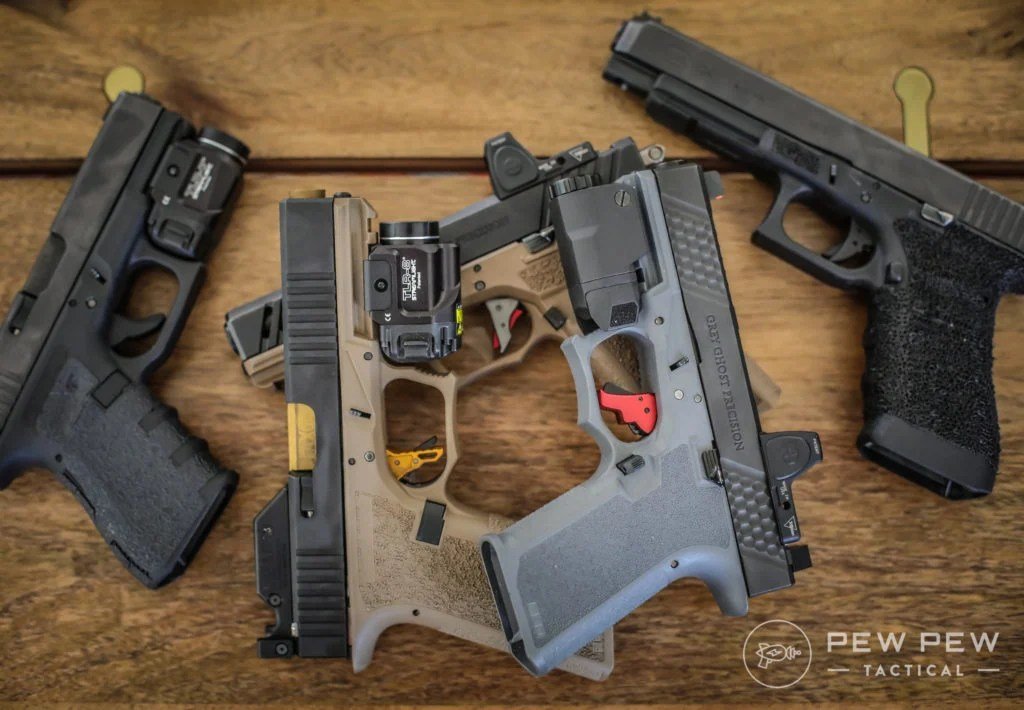
When you dive into the world of polymer-framed pistols, one name inevitably dominates the conversation: Glock. And if you’re looking to truly understand the brand’s evolution and find the right fit for your needs, a deep exploration of Glock Gen 3 Comparisons (Other Generations & Competitors) is absolutely essential. This isn't just about technical specs; it's about navigating a legacy of innovation, choosing a tool that perfectly matches your hand and purpose, and understanding why the Gen 3 continues to be a pivotal point in that journey.
For many, the Gen 3 Glock isn't just another handgun; it's a benchmark. Introduced at the turn of the millennium, it crystallized many of the features that define a modern Glock while simultaneously laying the groundwork for future advancements. But how does it stack up against its predecessors, its newer siblings, and the broader market? Let’s break down the details that matter most.
At a Glance: Key Glock Gen 3 Takeaways
- Pioneering Features: First Glock with a universal accessory rail, finger grooves, and thumb rests.
- Customization King: Boasts the largest and most diverse aftermarket parts ecosystem, making it highly customizable.
- Affordable & Available: Often the most budget-friendly Glock option, still widely produced and easily found.
- Reliable Workhorse: Shares the legendary Glock reliability and durability that defines the brand.
- Compared to Gen 5: Lacks the flared magwell, ambidextrous slide stop, and Glock Marksman Barrel of the newest generation.
- Compared to Gen 4: Does not have the modular backstrap system or larger, reversible magazine release.
- Ideal For: Shooters prioritizing customization, budget, or those who prefer the feel of finger grooves and a single recoil spring.
The Genesis of Glock: A Legacy Forged in Polymer
Before we dissect the generations, it's crucial to appreciate the foundation. Glock, the company, was founded by Gaston Glock in Austria in the early 1980s. A brilliant engineer with no prior firearm experience, Glock applied his expertise in polymers to create a revolutionary handgun for the Austrian military trials. The result was the Glock 17, affectionately dubbed the P80 in its home country, named for its impressive 17-round magazine capacity.
This original design, later known as the Gen 1, was radical: a lightweight, corrosion-resistant polymer frame, a simple trigger safety, and an unparalleled focus on reliability and ease of use. It redefined what a duty pistol could be, setting a new standard for firearm manufacturers worldwide. There were no accessory rails or finger grooves – just pure, functional simplicity. This minimalist approach was a stark contrast to the heavy, all-metal designs prevalent at the time, and it quickly garnered both fervent admirers and staunch critics.
The Gen 2, introduced in 1988, built upon this success with subtle but significant refinements. It brought improved ergonomics with added checkering on the front and backstraps for a firmer grip and a slightly improved magazine release. Critically, it expanded the Glock family beyond the original G17, introducing iconic models like the compact Glock 19, and venturing into new calibers such as .40 S&W (with the G22/G23) and even the subcompact "Baby Glocks" like the G26 and G27. These developments cemented Glock's position as a versatile platform suitable for a wider range of users, from law enforcement to concealed carry permit holders.
Enter the Gen 3: The Era of Customization and the Accessory Rail
If Gen 1 was the revolution and Gen 2 was the refinement, then the Gen 3 was the maturation. Introduced in 1998 (though production began a bit later for some models), it took the core Glock design and added features that were quickly becoming standard expectations in the firearms community.
The most noticeable and arguably most impactful update was the inclusion of a universal accessory rail under the barrel. This simple addition transformed the Glock from a standalone pistol into a modular platform, allowing users to easily mount flashlights, lasers, and other tactical accessories. For law enforcement and tactical users, this was a game-changer, integrating the pistol seamlessly into their equipment setup.
Beyond the rail, the Gen 3 also introduced the now-iconic finger grooves and small thumb rests on the frame. These were an attempt to improve ergonomics and provide a more consistent grip for a wider range of hand sizes. While some shooters find them perfectly natural, others find them restrictive or ill-fitting, a point of contention that would later lead to their removal in the Gen 5. A loaded chamber indicator was also a subtle but practical safety enhancement.
The Gen 3's enduring legacy, however, lies in its unrivaled aftermarket support. For years, it was the undisputed king of customization. If you could dream it, you could probably find an aftermarket part or modification for a Gen 3 Glock. This robust ecosystem means that even today, years after newer generations have emerged, the Gen 3 remains a top choice for those who love to tinker, personalize, and optimize their firearms. Coupled with its generally more affordable price point and continued widespread production, the Gen 3 offers an excellent entry point into the Glock family, or a solid base for a project build. If you're looking for an in-depth dive into this specific model, you might find our resource on All about Glock Gen 3 particularly helpful.
The Modern Divide: Gen 3 vs. Gen 4 & Gen 5
This is where the comparisons get interesting. The Gen 3 represents a significant evolutionary step, but subsequent generations brought their own host of improvements, addressing user feedback and pushing the boundaries of Glock's design philosophy.
Grip & Ergonomics: Finger Grooves vs. Modularity vs. Smoothness
- Gen 3: Defined by its finger grooves and subtle thumb rests. For many, these provide a secure, consistent grip. For others, particularly those with larger or smaller hands, they can be a nuisance, forcing an unnatural hold. The texture is a relatively smooth polymer.
- Gen 4: Addressed the ergonomics debate by introducing a modular backstrap system. This allowed users to easily swap out small, medium, or large backstraps to customize the grip size, making it more accommodating for diverse hand sizes than the Gen 3. It also featured the RTF (Rough Textured Frame) pattern, providing a significantly more aggressive and secure grip, particularly in adverse conditions.
- Gen 5: Made a bold move by removing the finger grooves entirely, reverting to a smoother, uniform grip profile reminiscent of the Gen 1 and 2. This was a direct response to user feedback, aiming to create a more universally comfortable and adaptable grip. It retains a less aggressive texturing than the Gen 4's RTF.
Controls & Usability: Mag Release, Slide Stop & Trigger
- Gen 3: Features a standard, smaller magazine release button. While functional, it requires a conscious effort for some shooters, especially those with smaller hands. The slide stop is ambidextrous only on very specific, less common models.
- Gen 4: Significantly improved the magazine release, making it larger and reversible. This was a welcome change, allowing left-handed shooters to easily configure the pistol for their dominant hand, and making reloads faster and more instinctive for everyone.
- Gen 5: Elevates usability further with fully ambidextrous slide stops as standard, directly benefiting left-handed shooters without requiring any modification. It also introduced an improved trigger feel and reset, often described as smoother and crisper right out of the box compared to previous generations, though still distinctly Glock.
Recoil Management: Single vs. Dual Spring
- Gen 3: Utilizes a single recoil spring assembly. This is a tried-and-true design, known for its simplicity and robustness.
- Gen 4 & 5: Both feature a dual recoil spring assembly. This system is designed to reduce felt recoil, making the pistol more comfortable to shoot, especially during extended range sessions or rapid firing. It also contributes to extending the service life of the pistol by better managing the slide's cycling forces. While some Gen 3 purists might argue it adds complexity, most shooters find the reduction in felt recoil beneficial.
Finish & Durability: Tenifer to nDLC
- Gen 3: Known for its durable Tenifer (a form of nitride treatment) finish on the slide, which provides excellent corrosion and wear resistance.
- Gen 4: Continued with a similar nitride-treated slide finish.
- Gen 5: Introduced the advanced nDLC (diamond-like carbon) finish on the slide and barrel. This finish is renowned for its superior corrosion and wear resistance, offering an even tougher and more aesthetically pleasing surface that holds up well to heavy use and harsh environments.
Accuracy & Barrel: Polygonal vs. Marksman Barrel
- Gen 3 & 4: Utilize Glock's traditional polygonal/rounded rifling (Gen 1–4 profile). This rifling is known for reducing bullet deformation and fouling, making cleaning easier and providing good accuracy for a duty pistol.
- Gen 5: A significant upgrade came with the Glock Marksman Barrel (GMB). The GMB features enhanced rifling and a refined crown, specifically designed to improve accuracy and barrel longevity. While Glocks have always been "combat accurate," the GMB aims to provide a noticeable boost in precision, especially at longer distances.
Aftermarket Ecosystem: The Customization Ladder
- Gen 3: The undisputed champion of aftermarket support. Its longevity and widespread adoption mean that virtually every conceivable upgrade, from triggers to slides to frame modifications, is readily available. If you want to build a truly custom Glock, the Gen 3 is often the most cost-effective and versatile starting point.
- Gen 4: Has a robust, but narrower, aftermarket compared to Gen 3. Many parts are cross-compatible, but the dual recoil spring system and modular frame introduced some unique components.
- Gen 5: Being the newest, its aftermarket is still growing. While many parts (like sights and magazines) are cross-compatible, others (like trigger components and specific frame parts) are not, leading to a slightly smaller selection for now.
Cost & Availability: New vs. Discontinued
- Gen 3: Often the most affordable new Glock you can buy. It's still widely produced and available from most retailers.
- Gen 4: Discontinued in 2020, meaning new models are no longer being manufactured. You'll find them on the used market, which can offer good value, but availability is limited to existing stock.
- Gen 5: The current flagship generation, it commands a premium price but offers the most refined out-of-box experience. French Armed Forces, for example, began replacing their service pistols with the Glock 17 Gen 5 in 2020, a testament to its modern capabilities.
Beyond Standard Generations: Specialized Glocks & Modern Needs
While the generational comparisons are key, Glock also offers specialized families and features that cater to specific user demands.
The Slimline Family: Designed for Deep Concealment
The traditional Glock frame, while compact for its capacity, isn't always ideal for deep concealment. Enter the Slimline family, a range of pistols designed with a significantly thinner profile and single-stack magazines.
- G42: Glock's smallest offering, chambered in .380 ACP, perfect for pocket carry or as a backup gun.
- G43: The 9mm equivalent of the G42, offering a potent cartridge in a tiny, 6-round package. It's a hugely popular choice for concealed carry.
- G43X: A slightly larger variant of the G43, it features a longer grip that accommodates a 10-round magazine (comparable to a G19 capacity in a much thinner profile), while retaining the G43's short slide. This makes it easier to grip while still being very concealable.
- G48: Essentially a G43X with a longer slide, giving it a longer sight radius and improved ballistic performance, while maintaining the slim 10-round grip.
These Slimline models are not strictly Gen 3, 4, or 5, but rather a parallel line designed for a distinct purpose. Many of them also come in MOS variants, catering to the growing demand for red dot sights. The aftermarket for these pistols is also robust, with options like the Shield Arms S15 kit that can upgrade G43X/G48 magazines to a surprising 15-round capacity.
MOS (Modular Optic System): Red Dot Ready from the Factory
The rise of micro red dot sights on pistols has revolutionized shooting, offering faster target acquisition and improved accuracy. Glock responded to this trend with its MOS (Modular Optic System) variants.
- What it is: MOS pistols come with a factory-cut slide designed to accept interchangeable adapter plates. These plates allow you to mount a wide variety of popular red dot optics directly to the slide without the need for custom milling.
- Benefit: This saves significant time and expense compared to having a gunsmith mill your slide. It also offers flexibility, allowing you to switch between different optic brands if your preferences change.
- Availability: MOS variants are available across many popular Glock models and generations, including Gen 4 (before discontinuation) and Gen 5 models like the G17, G19, G43X, and G48. If a red dot is in your future, an MOS model is a smart investment.
Crossover Models & Other Specialized Variants
Glock's innovation isn't confined to generational updates. They also offer "crossover" models and specialized configurations:
- G19X: Often seen as the precursor to the G45, the G19X combines a full-size Glock 17 frame (for a full grip and higher capacity) with a compact Glock 19 slide (for easier carry and draw). It famously comes in a coyote tan finish with unique Gen 5 internals.
- G45: Similar concept to the G19X (G17 frame, G19 slide), but it's a true Gen 5 model with a black slide, nDLC finish, flared magwell, and other Gen 5 features. It's quickly become a favorite for those wanting a balance of grip and concealability.
- Other Calibers: Glock offers pistols in a wide array of calibers beyond 9mm, including .40 S&W (G22, G23, G27), .357 SIG (G31, G32, G33), .45 ACP (G21, G36 slimline), 10mm Auto (G20), and even .45 GAP (G37).
- Competition Models: Longer slide variants like the G34 (9mm) and G35 (.40 S&W) are popular for competitive shooting due to their extended sight radius and reduced recoil.
- Compensated Models: The "C" suffix (e.g., G17C) denotes a compensated barrel and slide, designed to vent gases upwards to reduce muzzle flip during firing.
These diverse offerings highlight Glock's commitment to providing a pistol for nearly every purpose and preference, showcasing an internal "competition" between models to best serve specific niches.
Navigating the Market: When to Choose Which Glock
Given the extensive options, how do you decide which Glock is right for you, especially when comparing the benchmark Gen 3 to its siblings?
- For the Customization King (and Budget Builds): The Glock Gen 3 is your absolute best bet. Its unmatched aftermarket support means you can truly tailor it to your exact specifications, from triggers to slides to entire frame modifications. Coupled with its often lower price point, it's the ideal platform for a project gun or for someone who wants to personalize every aspect.
- For the Stock Perfectionist (and Enhanced Ergonomics): The Glock Gen 5 offers the most refined out-of-box experience. Its grooveless grip, ambidextrous controls, improved trigger, and Glock Marksman Barrel deliver superior ergonomics, accuracy, and overall shootability without needing any modifications. It's perfect for those who want to buy, shoot, and rely on their pistol as-is.
- For Ergonomic Versatility (on a budget, if found): If you can find a Glock Gen 4 on the used market, it offers a fantastic middle-ground. The modular backstrap system provides grip customization that the Gen 3 lacks, and the larger, reversible magazine release is a significant upgrade. The dual recoil spring also contributes to softer shooting.
- For Deep Concealment: Look no further than the Slimline family – specifically the G43, G43X, or G48. Their thin profile makes them disappear under clothing, and the G43X/G48 offer a surprising 10-round capacity in a very svelte package.
- For Red-Dot Readiness from the Factory: Any MOS variant is the smart choice. Don't waste time and money on custom slide milling when Glock offers factory-ready solutions.
- For a Full-Size Duty or Home Defense Pistol: A full-size Gen 5 G17, or a crossover G45, provides excellent capacity, manageability, and modern features.
Glock Against the World: A Nod to Competitors
While this article focuses on Glock's internal evolution and comparisons, it's worth acknowledging that Glock doesn't exist in a vacuum. The polymer pistol market is fiercely competitive, with brands like Sig Sauer, Smith & Wesson, CZ, Heckler & Koch, and FN Herstal all offering excellent alternatives.
What makes Glock continue to stand out, and why is the Gen 3 still so relevant?
- Unwavering Reliability: Glock's reputation for going "bang" every time, under any conditions, is legendary. This core strength is shared across all generations.
- Simplicity of Design: The elegant simplicity of Glock's Safe Action system, with minimal external controls, contributes to its robustness and ease of use.
- Consistency: While generations introduce updates, the fundamental Glock manual of arms remains consistent, making it easy to transition between models.
- Vast Ecosystem: Even beyond the Gen 3, the overall Glock aftermarket for parts, holsters, and accessories is arguably the largest of any handgun brand.
- Value: Especially with the Gen 3, you're getting a proven, reliable, and highly customizable pistol at a very competitive price point.
The "competitors" for a Gen 3 might not just be other brands, but also other Glocks within the family. For example, a shooter might weigh a Gen 3 G19 against a Gen 5 G19 for different reasons (customization vs. out-of-box features). Similarly, a Slimline G43X might compete with a Gen 3 G26 for concealed carry, each offering different trade-offs in size, capacity, and grip feel.
Your Glock, Your Choice: A Buyer's Action Plan
Ultimately, the "best" Glock isn't determined by a spec sheet or an internet forum; it's determined by you. Here’s how to make an informed decision:
- Hands-On Testing is Non-Negotiable: Visit a local gun store or, even better, a range that offers rentals. Hold as many different Glock models and generations as you can.
- Assess Grip Fit: Pay close attention to how the grip feels in your hand. Do the Gen 3 finger grooves align comfortably? Do you prefer the grooveless Gen 5? Do the Gen 4 backstraps make a difference?
- Trigger Reach & Quality: Can you comfortably reach the trigger? Does the trigger pull and reset feel good to you? While subjective, the Gen 5 often wins here for its out-of-box feel.
- Control Access: Can you easily manipulate the magazine release and slide stop? This is especially crucial for left-handed shooters, where the Gen 4's reversible mag release and Gen 5's ambidextrous slide stop are clear advantages.
- Recoil Impulse: If possible, shoot different generations side-by-side. Notice the difference the dual recoil spring (Gen 4/5) makes compared to the single spring (Gen 3).
- Consider Your Purpose: Are you looking for concealed carry, home defense, range fun, competition, or a duty weapon? Your primary use case will heavily influence the ideal model and generation.
- Budget & Customization Goals: How much are you willing to spend? Do you plan to leave it stock or modify it extensively? Your answers will guide you toward the Gen 3 for budget and customization, or the Gen 5 for a premium stock experience.
- Verify Parts Compatibility: Remember that while many parts (like sights and magazines) can cross-fit between generations and models, critical components like recoil assemblies, trigger modules, and certain frame parts are often not interchangeable. Always double-check compatibility before purchasing aftermarket parts.
Choosing a Glock is an investment in reliability, durability, and a proven design. By understanding the nuanced differences between the Gen 3, its predecessors, and its modern counterparts, you'll be well-equipped to select the perfect pistol that truly feels like an extension of yourself. Happy shooting!